Time for another monthly post sharing some of the IT discoveries that crossed my path lately. Below you’ll find a mix of articles, links, and resources, some of which tie into my current activities and areas of interest.
01Some thoughts
PyCon NL
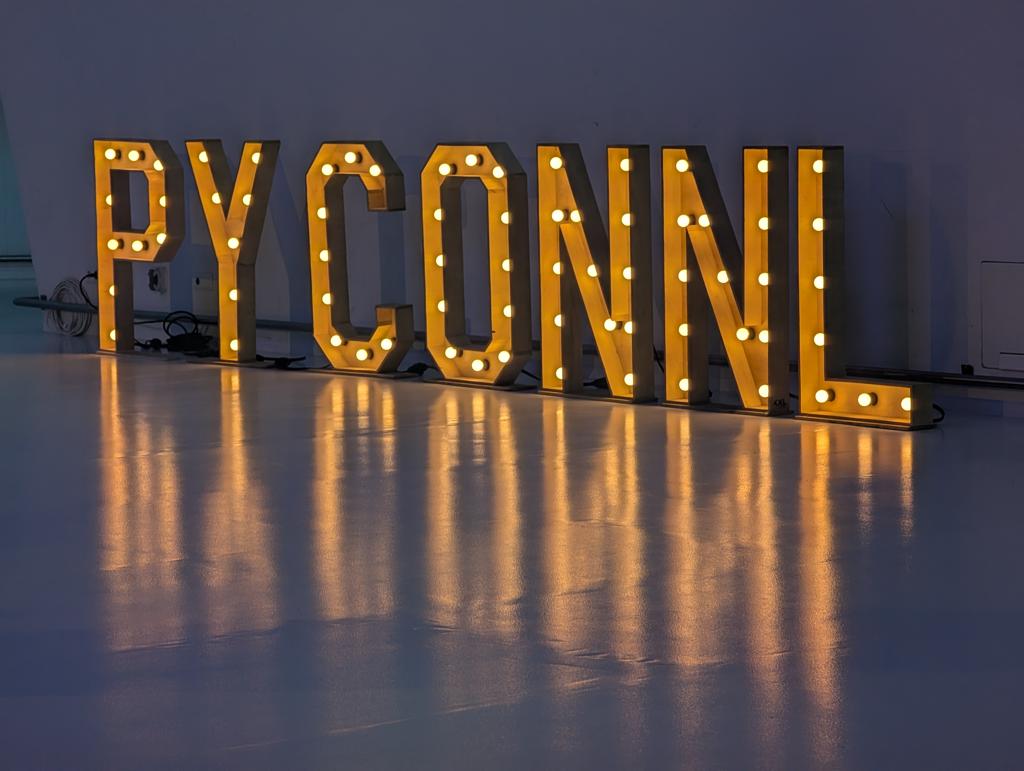
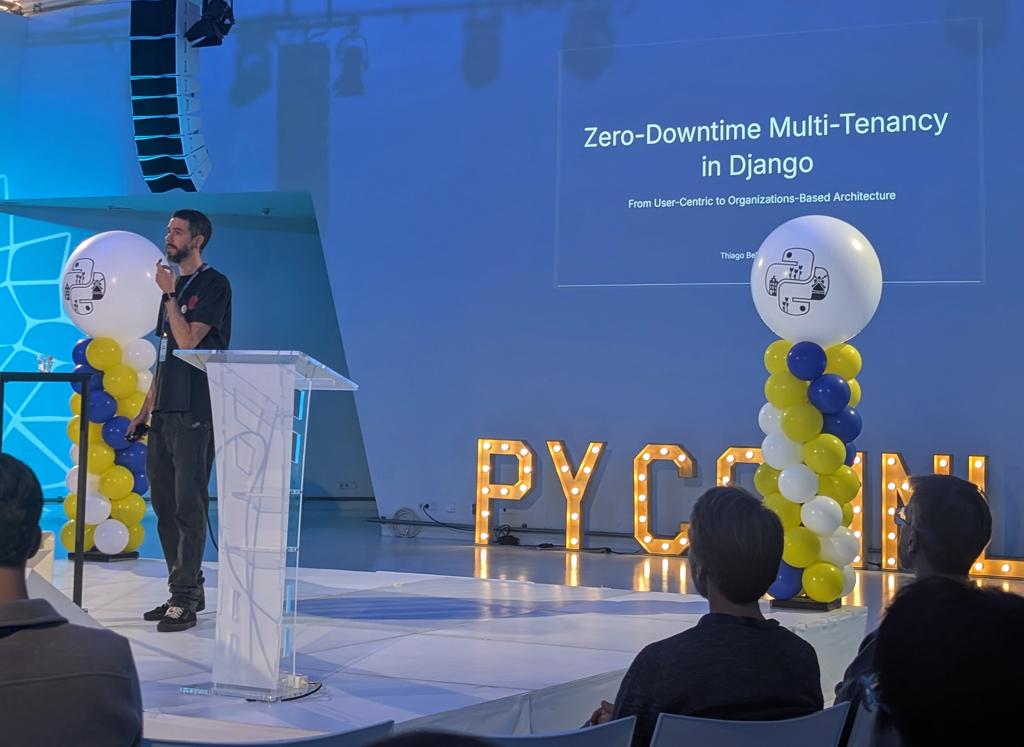
I always had some excuse to skip PyCon NL, but this year I was committed, especially since it’s a very short commute for me. I’ve only been to a few PyCons (CZ and PL), and I’d consider the Dutch one a cozy event. It was hosted in Utrecht: a single stage with some workshops on the side, a few booths, and arcade games. The gold sponsor was Sendcloud, where I worked previously, and they had a great crew there. It was pretty cool to see a bunch of folks I shared the trenches with, and I also met a few new ones (Sendcloud is hiring, by the way). I was especially interested in a talk by Thiago Bellini Ribeiro (Sendclouder) on Zero-Downtime Multi-Tenancy in Django: From User-centric to Organizations-based Architecture. Working with decade-old monoliths is always a struggle, and it was an insightful take on how to pull off a migration like that, especially since I know that codebase firsthand, remembering how coupled everything was to User.
Blog redesign
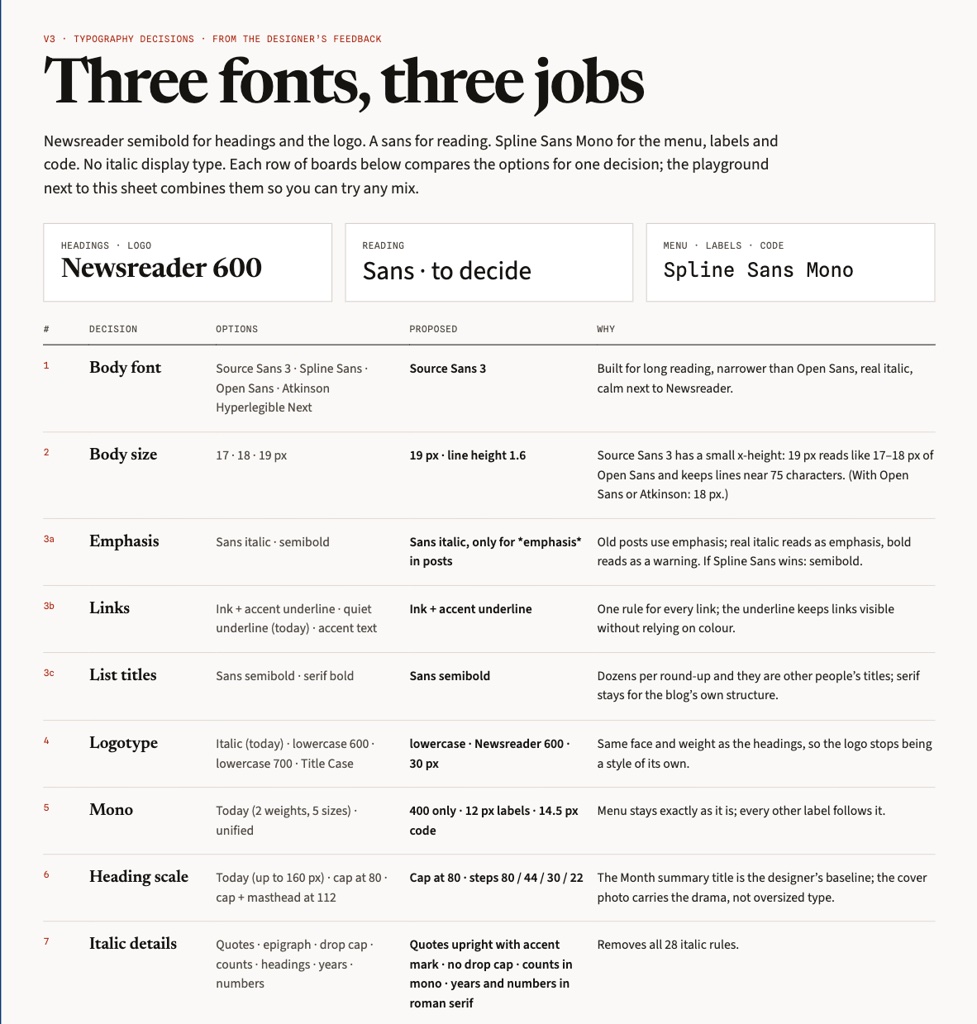
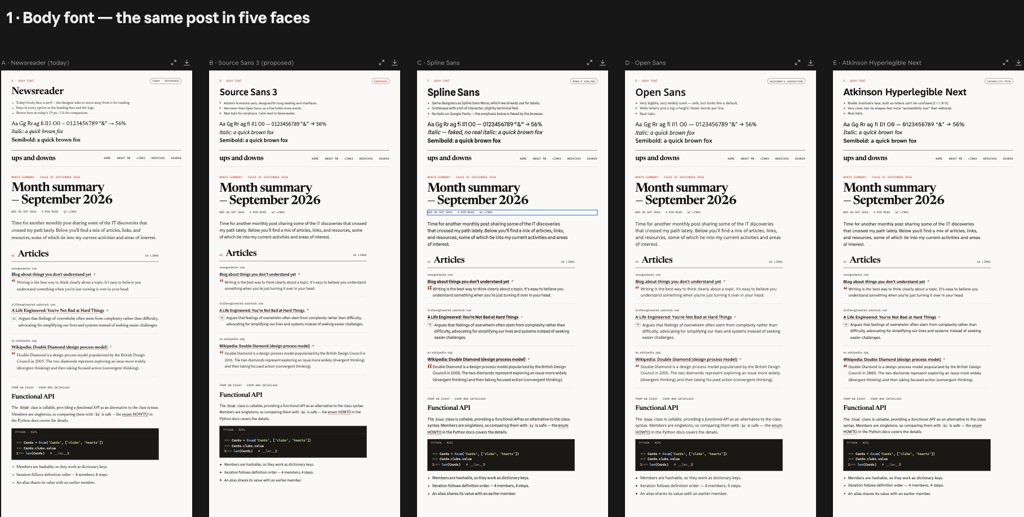
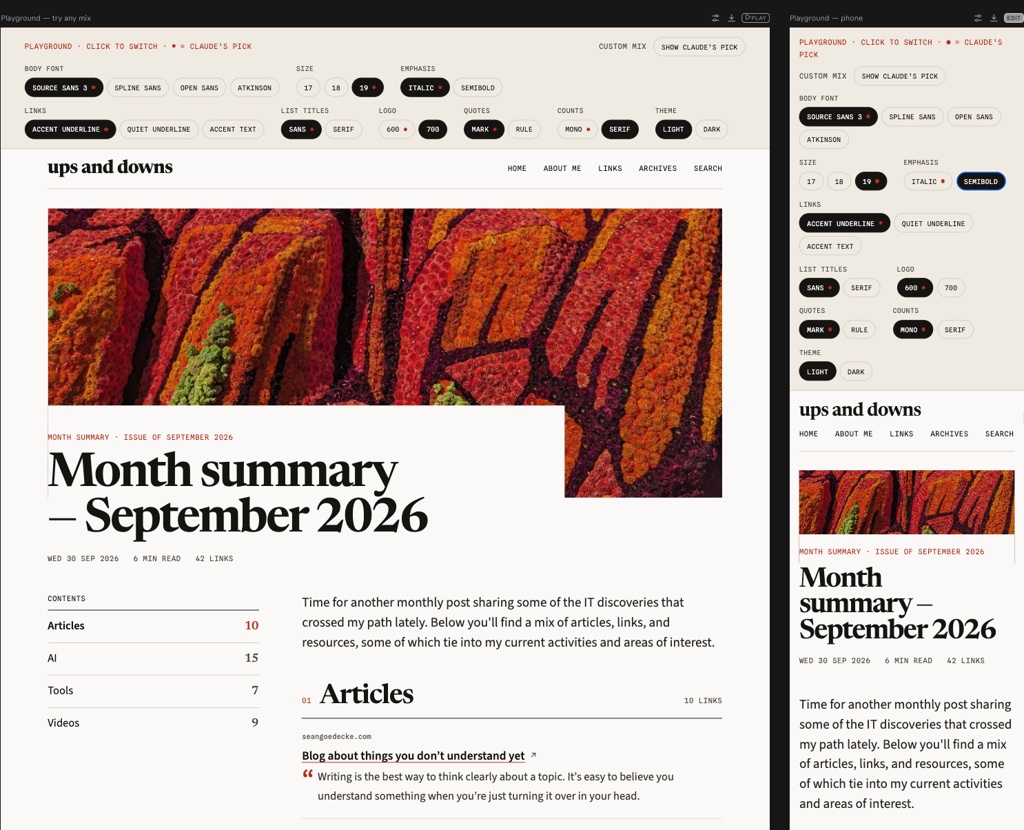
I don’t think anyone noticed, but I redesigned the blog again and went deeper into Claude Design. I put together a board with six proposals, chose the one I liked most, and spent some time with claude-code turning it into a Hugo template. I was kind of happy with the result, but I still had this itch that something was off. I didn’t trust myself anymore: I’d spent too much time working on it and felt I’d lost perspective. I needed outside eyes. Not many people can give reliable feedback beyond “I like it” or “I don’t like it.” But I knew whom to ask: none other than my friend Konrad. His feedback was straight to the point: too many fonts, creating too much noise. And he even suggested a few alternatives. I went back and built an interactive mockup so I could easily switch between options and get an instant visual of how the page would look. That made choosing much easier, and I finally got the blog to match my taste.
Blog posting
I got feedback about my blog that the links are cool, but my posts lack a personal take. And I agree. I kind of hesitated to share. My English isn’t perfect, though with AI around to help catch rough edges, that’s not really an excuse anymore. Writing personal notes already helps a lot to clarify thinking, and I’m doing cool stuff at work and in my free time, so why not write more about it (IT)? I like having fun with computers, tinkering with my terminal, playing with new tools, and reading both IT-related and unrelated articles, getting some new inspiration and ideas, and connecting them to my own view and journey. Especially now, in the middle of the AI storm and an overwhelming flood of slop, I want to work on my own writing. It feels like an important skill to keep sharp in a world where anyone can generate infinite lines on any topic with zero clue about it. Sometimes I catch myself reading a post only to realize the author probably didn’t even bother reading it themselves, let alone understanding it. I can write slop all by myself! Carefully, manually crafted in Neovim.
While digging into this topic, I also put together a dedicated page with links on writing and blogging collected from my posts over the years. One from this month hit especially close to home: Joel Hooks’s Stop Giving af and Start Writing More , which sums up why I’m not doing this for views, just for fun:
The idea of a “blog” needs to get over itself. Everybody is treating writing as a “content marketing strategy” and using it to “build a personal brand” which leads to the fundamental flawed idea that everything you post has to be polished to perfection and ready to be consumed.
— Joel Hooks
02Articles
18 linkswpollock.com: Unix File and Directory Permissions and Modes
Unix and Linux systems (including Mac OS X and other POSIX compliant systems) have a (relatively) simple system for controlling access to files and directories.
The Beautiful Mess: TBM 442: 10 Career Traps (Thoughtful People Fall Into)
In this post, I’m going to share ten career traps thoughtful people often find themselves ensnared in.
Calibre: It’s official: Airline websites are slow, but they don’t have to be
Our analysis of 111 airline websites confirms what travelers already know: they are agonizingly slow, but straightforward performance optimizations could change that.
bobble.tech: Used ThinkPad Buyer’s Guide
Buying a used ThinkPad is one of the best value propositions in computing, provided you know which models have legendary keyboards and which to avoid.
Derek Sivers: Uncommon Sense - live @ WDS
What you need to avoid is this deathbed regret that you’ve pursued something that someone said you should want instead of what you really want. When you choose the thing that you are most into, that means that you need to optimize for that, and be willing to let go of the others.
The Phoenix Architecture: The Spec Can Come Later
With AI, we can hack together a prototype first and let the machine help us extract the specification later.
Jacob Tomlinson: Writing blog posts while walking the dog
I’m excited about how AI is changing how I work, it has made me more productive and able to get more things done. I’m also frustrated by how much low-effort content is being generated and sprayed across the internet.
Refactoring English: Anti-Patterns in Software Blogging
In software development, we collect anti-patterns to recognize common traits that lead to poor outcomes in our software. I thought it would be helpful to do the same for software blogging, so I’ve catalogued the most frequent mistakes I see from beginner bloggers.
GitHub - alex/what-happens-when
An attempt to answer the age old interview question “What happens when you type google.com into your browser and press enter?” — covering everything from keyboard interrupts and OS syscalls to DNS, TLS, and rendering engines.
Architecture Weekly: Sharing is (not always) caring. PgBouncer pooling modes in practice
When you configure PgBouncer, you need to choose a pooling mode. This choice clearly affects how connection sharing works and, in turn, performance. It also affects which database features will work.
Nas: How Does Instagram Instantly Know If Your Username Is Available?
Type a handle into a signup form and a green tick or a red cross appears almost before you stop typing, checked against a billion names. It isn’t one clever database query. It’s a debounced client, a Bloom filter that answers ‘definitely free’ from memory, an index for everything else, and a unique constraint that has the final say.
Vice Console: What I Self-Host
So, I “cut the cord” in a different sense, ditching streaming services for self-hosted Jellyfin. Over the course of the next year and a half, Jellyfin opened the door to self-hosting many other services, reducing my dependence on cloud service providers, and providing a welcome stability.
A Life Engineered: Worth Repeating: The Art of Showing Up
The fastest way to get things done is to forget the finish line.
A Life Engineered: The Mistakes You Can’t Take Back
Most decisions are two-way doors, meaning you can easily reverse them. But some decisions are one-way doors—you can’t take them back.
A Life Engineered: Worth Repeating: Are You Accumulating Career Debt?
Career debt is the accumulation of obsolete skills and missed opportunities, a quiet tax on your future professional mobility.
A Life Engineered: Worth Repeating: How I Have Time For Everything
Having time for everything isn’t about fitting more into your day; it’s about ruthlessly eliminating what doesn’t matter and fiercely protecting your slack.
A Life Engineered: On the Death of Amazon’s Writing Culture
With AI, you can trivially produce six pages, no critical thinking required. But that writing process, as described (and prescribed) by Bezos, used to guarantee that the author of a memo would have done the necessary thinking before asking for an hour of everybody’s time. That guarantee has gone.
A Life Engineered: You Are What You Read
A six-page memo worthy of an Amazon presentation would take at least a week to write. Nobody spent a week on something they didn’t care about, so the fact that a document existed at all told you something about the effort that had gone into it. That world has gone. Why? Because now that writing is essentially free, it has lost its underlying value.
03Productivity
3 linksForte Labs: Progressive Summarization: A Practical Technique for Designing Discoverable Notes
Modern digital tools make it easy to “capture” information from a wide variety of sources. We know how to snap a picture, type out some notes, record a video, or scan a document. Getting this content from the outside world into the digital world is trivial.
Jacob Tomlinson: Why taking notes still matters
With people moving to AI note takers it feels like the “it’s all in the textbook” approach is being adopted en-masse, but where the textbook for every topic writes itself automatically. Textbooks are great, but notes are great too!
Joel Hooks: 🖋 Stop Giving af and Start Writing More
In 2019 I wrote more than the previous 5 years combined, at least publically.
04AI
14 linksohhfishal: Claude Says….
I don’t care. If I wanted the feedback of an AI, I would have prompted it myself.
claude.dev: Automating eval design and hillclimbing with Claude
Principles for designing evals and hillclimbing against them without fooling yourself, and how the claude-api skill’s build-eval and hillclimb commands put them to work.
GitHub - affaan-m/ECC
The agent harness performance optimization system. Skills, instincts, memory, security, and research-first development for Claude Code, Codex, Opencode, Cursor and beyond.
stoppels.ch: Wake me up when AI can…
A few weeks back I was (once more) impressed with a new release of a frontier model, and realized it was still 2026, about three quarters through the year, the same year I discovered coding agents were becoming useful.
Fatih Arslan: How I manage my agents
By using a simple markdown index, I can maintain a high-level overview of all my active agents, their current state, and the overarching goals they are pursuing.
Atlassian: The AI SDLC transformation playbook
The AI-native software development lifecycle (SDLC) goes far beyond having developers adopt coding agents. As less time is spent writing code by hand, coding itself is evolving from a synchronous, single-threaded task into an asynchronous, multi-threaded one.
AI 2027: A research-backed AI scenario forecast
We predict that the impact of superhuman AI over the next decade will be enormous, exceeding that of the Industrial Revolution. We wrote a scenario that represents our best guess about what that might look like.
ghuntley.com: If your team is too busy doing their ’normal job’ to experiment with AI, you’re preparing them to be replaced
Artisanal handwritten code is only possible for retired tech executives and as a hobby at home, but it’s no longer a way to make money. You can push against the grain and refuse to use AI, but that’s just self-harm.
The Pragmatic Engineer: The state of the tech industry in 2026
Nearly all of the most productive software engineers I’ve met – who were hand-writing code a year ago – no longer write the code by hand and also run several parallel agents. Food for thought: there were more agent-authored PRs in August 2026 on GitHub than human-authored ones!
Simon Willison: I built a new feature for my blog using my voice
I shipped a new feature for my blog: the Newsletters page, which offers an index of all of the newsletters I’ve sent out. I built the feature almost entirely using my voice, chatting away to my laptop while I cooked dinner.
Context First: Superlite: Hand an Agent a Spec, Come Back to Tested Work
Why I built superlite, an autonomous build workflow for Claude Code that doesn’t ask permission every four minutes: how it works, how to use it, and the benchmarks.
InfoQ: AI is an Amplifier: Scale High Performance, Not Dysfunction
Nathen Harvey shares insights from DORA research on AI adoption in software delivery. He explains why AI acts as an amplifier, how the DORA AI Capabilities Model drives outcomes, and why engineering leaders must evolve beyond bottlenecks like code reviews to achieve sustainable productivity, reduce delivery instability, and empower developers without burning out their teams.
Cloudflare Blog: Cutting our inference bill by 68% by being obsessive about optimization
With code quality at high effort, the average review now costs just $0.77, down 68% from the $2.43 it averaged over our two most expensive weeks before we started. Our main goal was to cut costs, but as part of this work we also managed to optimize the reviewer, so that the median review now takes just 1m 32s instead of the 4m 09s it took before.
Orestis Ioannou: AI Promised Less Work. I Have Never Worked More.
Somewhere this year I noticed that I am working more than I ever have, and that it feels heavier than it used to. Not because any single task is harder. Because there are so many more of them, all at once.
05Tools
5 linksGitHub - crmne/spotifast
Spotify, native and fast. One lightweight Rust app for your whole library, local playback, and Spotify Connect on Linux, macOS, and Windows.
tinyjs: desktop apps for macOS, Windows, and Linux in ~6 MB
tinyjs is a tool for building desktop apps with HTML, CSS, and JavaScript, weighing in at a mere ~6 MB without the heavy Chromium overhead.
GitHub - koreader/koreader
An ebook reader application supporting PDF, DjVu, EPUB, FB2 and many more formats, running on Cervantes, Kindle, Kobo, PocketBook and Android devices.
GitHub - firecracker-microvm/firecracker
Firecracker is an open source virtualization technology that is purpose-built for creating and managing secure, multi-tenant container and function-based services that provide serverless operational models.
GitHub - mother-of-all-self-hosting/mash-playbook
MASH (Mother-of-All-Self-Hosting) is an Ansible playbook that helps you self-host services as Docker containers on your own server.
06Podcasts
1 linkThe Ezra Klein Show: Bill Gates’s Blunt Warning on A.I.
Current AI alarmism does not go far enough. The idea that the tech industry can effectively self-regulate is insane when facing threats like catastrophic cyberattacks, bioterrorism, and rapid mass job displacement.
07Videos
6 videos · play right here · tap to play I Think I Found the Cheapest Way to Build a NAS
 The Diary Of A CEO: Ex-Google Officer: You Only Have 3 Years Left Before It Hits! - Mo Gawdat
 Beyond Coding: Why The Best Software Engineers Focus On System Design
 The Pragmatic Engineer: Uber’s AI infra, from the inside
 A Life Engineered: What Senior Engineers Are Actually Doing About AI